
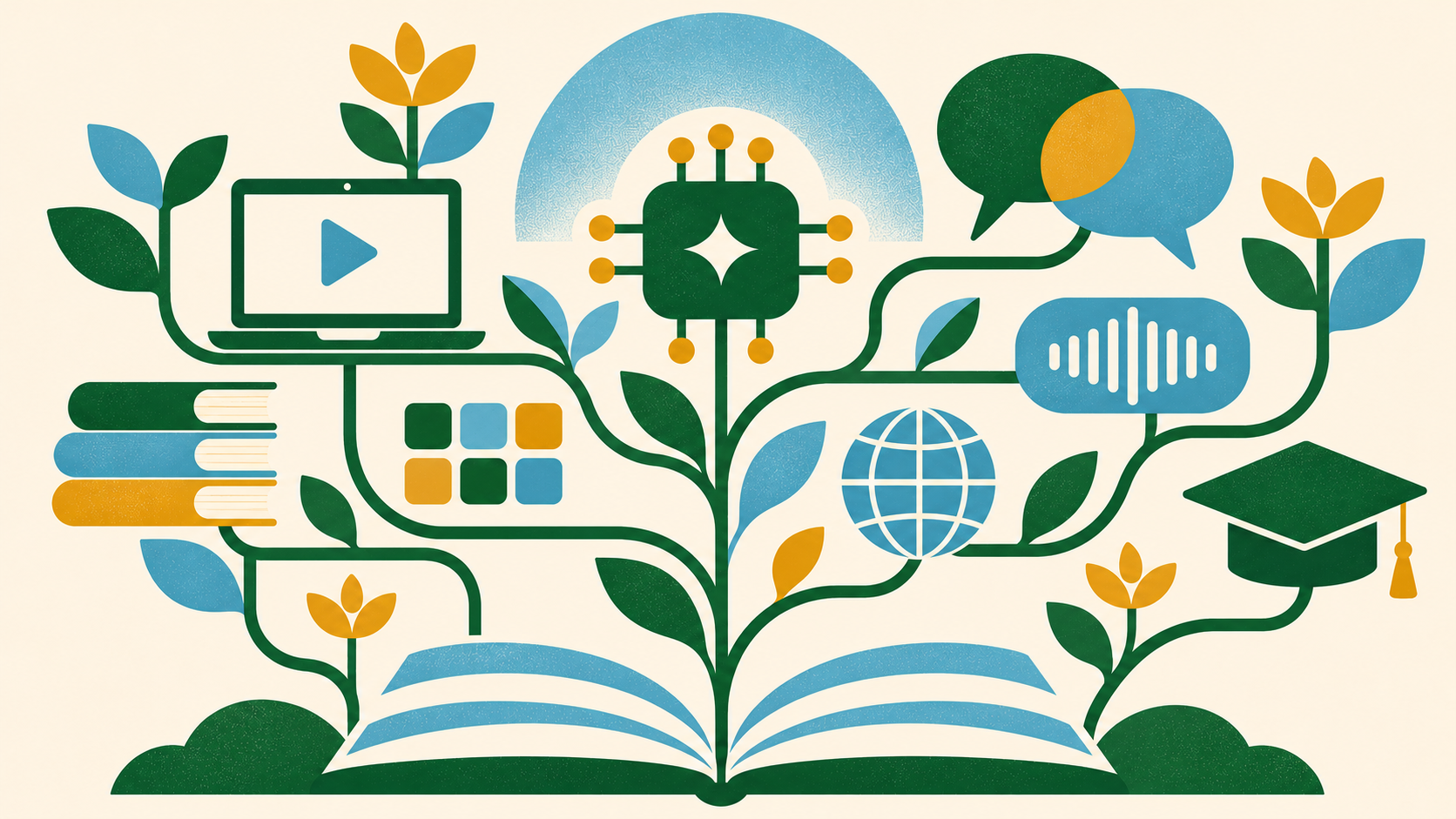
On 12th November 2026, I returned to my former school, BG/BRG Lichtenfels in Graz, to give a 30-minute talk on the future of the digital classroom in German. The talk started with a short, hands-on look at how generative AI works: words become numbers, and language models predict the next token. A probable answer is not necessarily a true one.
From there, I presented examples from our work at Graz University of Technology in three areas:
- Innovative teaching and learning formats: eight scenarios for integrating MOOCs into one’s own teaching, the flipped-classroom course prompting.school, and aicast.fyi, an open-source tool for personalised, AI-supported learning podcasts.
- AI-supported tools in higher education: the InfoFit chatbot in a MOOC, LLMduckt for digitally sovereign LLM access in teaching, collab.prompting.school for reflecting on AI chats together, and AI-generated video paths and multilingual avatars.
- Projects fostering digital competences: the free MOOCs “Generative KI” and “Level-Up-CS” on iMooX.at.
A “real or AI?” image and the story of a genuine Monet that was criticised after being posted as an “AI image” showed how strongly assumptions about origin shape our judgement.
The talk closed with the concept of a postgenerative world, in which generative AI pervades everyday life and affects even people who don’t consciously use it. It also covered the German Science and Humanities Council (Wissenschaftsrat) call for intellectual sovereignty as a guiding principle for universities.
Image generated with ChatGPT 6.1 Sol